Monday, April 20, 2015

Nelson Mandela

Nelson Mandela is well-known in Africa for being the president of South Africa. On this website, it gives information about Mandela's presidency. Nelson Mandela became South Africa's president on May 10, 1994. During his presidency, he did the following things:

  • In 1995, he created the Truth and Reconciliation Commission
    • This looked into discrimination and human rights
  • Introduced new ideas to develop Africa's black population's living standards
    • Housing, education, economic development designs
Image result for truth and reconciliation commission
In 1999, Mandela's first term as president was over, and he did not run for a second term as Africa's president. Thabo Mbeki became president after Mandela. When Mandela left his presidency, he also resigned from active politics, but he still remained involved by promoting peace, compromise, and social justice. He often did so by working through the Nelson Mandela Foundation, which was founded in 1999. In 2007, he was also a founder of the Elders, which advocates for solving conflicts and problems around the world. 


Image result for nelson mandela nobel peace prize
Nelson Mandela receiving the Nobel Piece Prize

Nelson Mandela now has a day that was created to recognize all he had done. The day is called Mandela Day and is celebrated on Mandela's birthday, July 18, 1918. On this day, people around the world are encouraged to participate in community service.


Image result for mandela day
Volunteers participating in Mandela Day

Saturday, April 18, 2015

The Struggle for African Women

I found an interesting article on the struggle for African women. In the earlier years of African history, there had been a time of inequality, where blacks and colored people were "less than" whites, and women were inferior to men. Through this though, South African women played a huge role trying to fight for equal rights before any organization was even thought of. Women began to fight for what they believed in. Indian women encouraged Black and Indian miners to protest against starvation wages. In 1913 Black and Colored women fought against the requirement of carrying identity passes, while it was not necessary for White women to do so.


In 1918, the first women's organizatoin, Bantu Women's League, was started up by Charlotte Maxeke. It was constructed to refuse the pass laws. Throughout the 1930s and 40's, women continued to take part in campaigns, and by 1943, women were able to be apart of the African National Congress. In 1948, Ida Mntwana established the ANC Women's League, and she was the organization's first president.

Ida Mntwana, president of ANC Women's League

In 1952, there were many women who participated in the Defiance Campaign. Two years later, the Federation of South African Women was created. This brought women from the ANC, the South African Indian Congress, trade unions and self-help groups together for the very first time. A women's Charter was drawn up which promised to end abolish discriminatory laws. 

Women went through a lot during this time, trying to fight for the equality of men and women. Even through these hard times, women leaned on other women to keep them fighting for their equality. 


Monday, April 13, 2015

A Little About Africa...

In an article that I read, it gave a lot of interesting information about Africa as a continent. As the second largest continent, there are many different things that can contribute to Africa's warm temperature. Africa is divided pretty much into two parts. The region of Africa that encounters hot temperatures and a lot of rainfall throughout the year is located near the Equator. The dryer regions of Africa are located closer to the tropics.
Rain forest climate in Africa

Dry climate in Africa

The northern half of Africa tends to be dryer and hotter, while the southern half is more damp and chilly. This is because of the unsymmetrical shape of Africa's northern and southern regions. Since the southern half is narrower than the northern hemisphere, it is affected greater by oceanic factors. 

Farming is affected tremendously in Africa by the climatic factors. It is known to be the most important economic activity in Africa, and two-thirds of Africa's working population works in agriculture.


Wednesday, March 25, 2015

Africa's Involvement in the World Wars

As I was working on my presentation for my African Cultures class about how World War I and World War II affected Africans, I came across an interesting website talking about the forgotten stories of African involvement in the war. I found out that out of all the World War I campaigns, the longest was the East African one. As the years pass, people continue to honor those involved in the war, directly and indirectly, but no one seems to know about Africa's side of the story, even though they too lost a lot of soldiers during battle. Africans also faced a considerable amount of consequences dealing with the future of Africa.

The East Africa campaign involved a lot of moving around, quick invasions and long journeys on foot. There were only 25,000 German Schutztruppe, white German commanders and black African soldiers, while The British created 150,000 armed forces. The British army started with South Africans and Indians and were later unified by Kenyans and Nigerians.


For every one soldier that the German and British army had, they had four porters. A porter was someone who brought food, weapons and artillery to the soldiers. They also cooked, cleaned and cared for the soldiers needs. These porters comprised of women and children, and they often passed away due to tiredness, lack of nutrition, and diseases. The British armies had 105,000 deaths and 90% of that were the porters. That's 94,500 deaths alone for the people who were taking care of the soldiers. About half of those deaths were people from British East Africa, which is now Kenya. 


Thursday, March 12, 2015

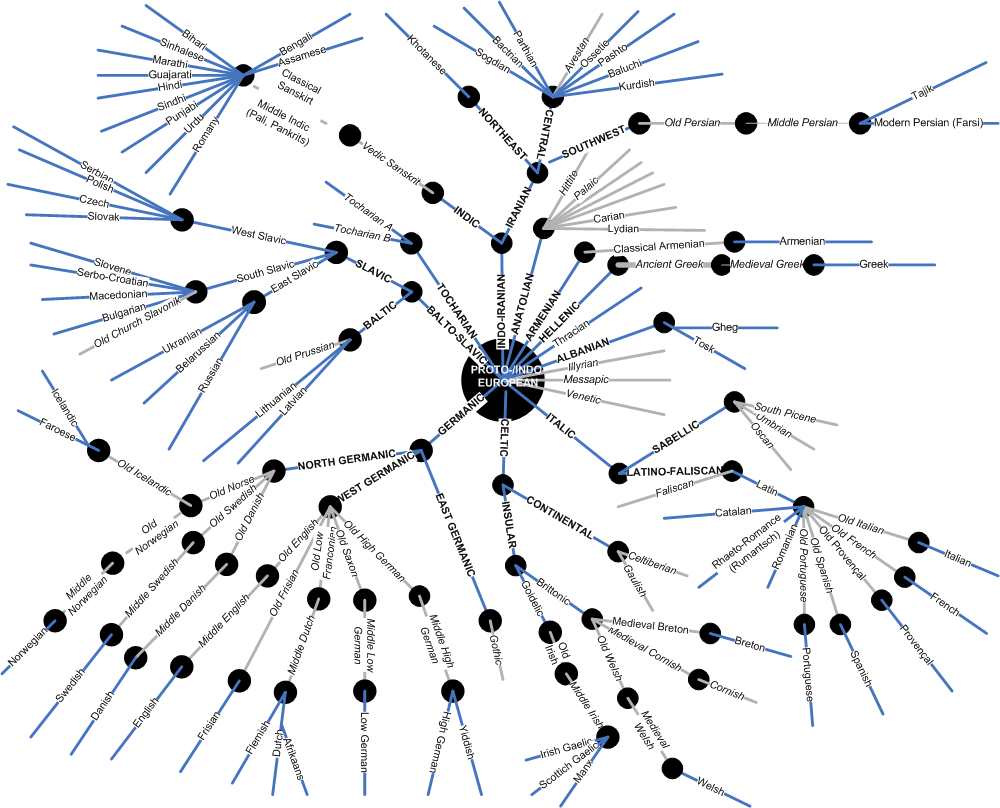
Language Born in Africa

In an article that I came across, in the New York Times, it discusses how a researcher who was analyzing the sounds in different languages spoken all around the world determined an ancient signal that points to southern Africa as the place where modern human language originated. Discoveries of evidence of fossil skulls and DNA matches this finding that modern humans originated in Africa. This article suggests that modern language originated only once, which has caused great controversy. 

Some linguists find this discovery shocking, and believe that since words change so quickly, languages can't be traced very far back in time. The earliest language tree goes back only 9,000 years at the most, according to this article. A biologist at the University of Auckland in New Zealand named Quentin D. Atkinson has found ways of making that a false statement. He looked at phonemes instead of individual words. Through doing this, Dr. Atkinson found a pattern in around 500 languages spoken all over the world. According to his discovery, the farther away that early humans traveled away from Africa, the fewer phonemes that language area uses.


The map above shows the number of phonemes around the world. As Dr. Atkinson said, the further away from Africa, the less phonemes that are used. 

Dr. Atkinson said that the pattern of decreasing diversity with distance as well as the decrease in genetic diversity with distance from Africa, signifies that southwestern Africa is where modern human language originated. His findings were published in this article

I find Dr. Atkinson's findings to be very interesting. He put in a lot of time and effort to discover his claims that language all originated in Africa. 


Here is a picture of the language trees with all of the different languages.


Saturday, March 7, 2015

Ebola in Guinea

I came across an interesting article about ebola from February 21, 2015. Since ebola was a well-known topic this past year when it came to Africa, I thought it would be an interesting blog topic. The subtitle of the article is "To end the outbreak in west Africa, Ebola must be snuffed out where it began." The article states that there have been over 9,300 deaths in western Africa caused by ebola. 

Above is a map of where ebola has occurred in Africa. 
The darker the color, the more cases that have been identified. 

Since cases of ebola have spread throughout Africa, it has made it a lot more difficult to end the epidemic. Just in the week that this article was written, (February 21) there had been 128 new confirmed cases, and over 800 in the fall of 2014. Most of the cases were in Sierra Leone, but according to the article, they are more worried about Guinea because most of the cases there were people who health workers did not even suspect having ebola. In order for ebola to be contained, those with the virus must be isolated, but if these people are not even known to health workers, then it is almost impossible for the virus to be ended. While people in Liberia and Sierra Leone have begun to take caution and changing their behavior in order to stop the spread of ebola, people in Guinea have not taken that sort of care. There, they kiss and shake hands, unafraid of catching ebola.

The article states that the longer the virus continues, the harder it will be to completely stop it. Since there have been so many cases that healthcare workers did not even know about, it makes it very difficult to end the virus. 

Wednesday, February 25, 2015

African Romance

While reading this website, I found it very interesting how several famous and well-known authors, publishers, writers, translators and readers came together to write The Valentines Day anthology. I wasn't sure of the definition of anthology, so I looked it up and found it here. I have never heard of anyone doing this before, and the article discusses how Africa was able to come together and make this happen. As the website shows, two of the titles that were published are called "A Tailor-Made Romance" and "The Elevator Kiss." It amazed me that every title that was published by Valentines Day were all 1,000 words or less. I looked up the story "The Elevator Kiss" and there, I found a short synopsis of the story:

After her disastrous breakup with her fiancĂ© the only thing on Sindi’s mind is rebuilding her life. Little does she know that an innocent invitation, a certain mistletoe and a sprinkle of holiday spirit would be the catalyst of a steamy and passionate affair that breaks all the rules right from the bat. The Elevator Kiss features gorgeous locations, cosmopolitan characters, sneaky villains, drama and of course romance.

The website also discussed how the purpose of writing these short stories was so people could read about different romance stories from different culture's perspectives and see what they actually mean to them.